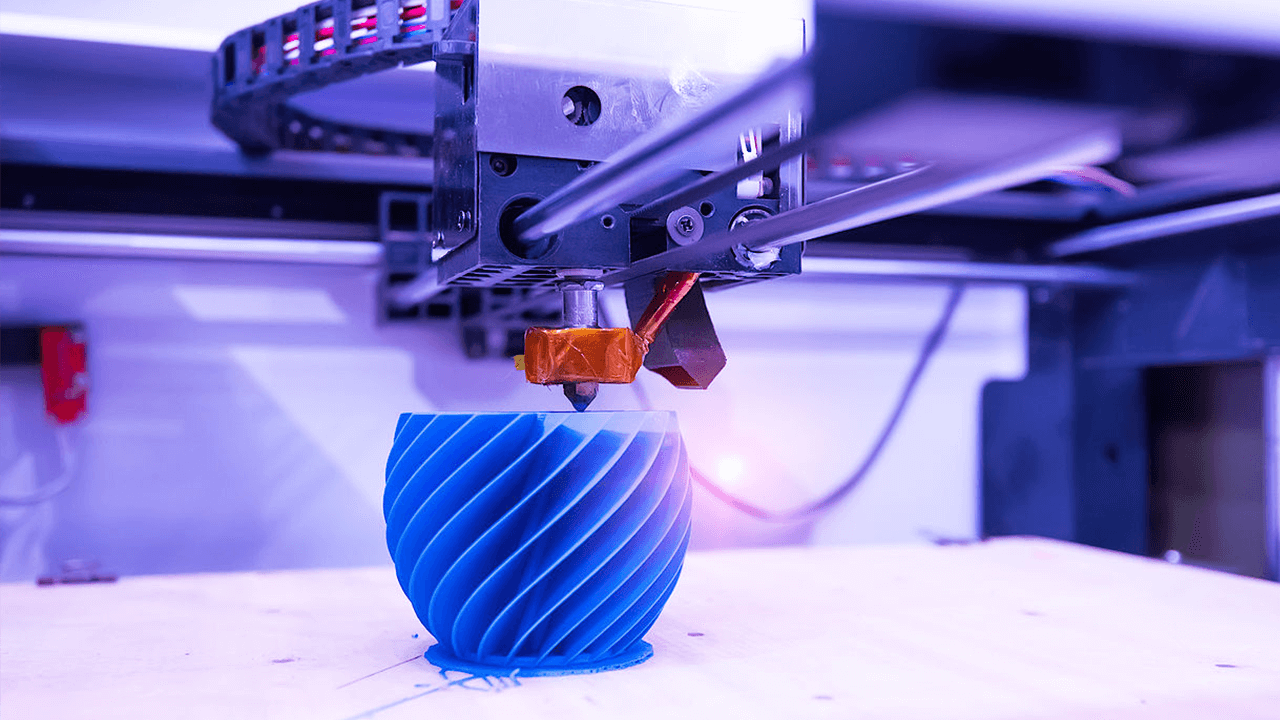
3D printing ability to spot-make components, or small batches of them, is appealing to several parties in the supply chain process for certain types of products, especially commodity-type component items. As 3D printing technology and its materials have improved, such printers have become cheaper and more commercially available, leading to even further advancements — both in the speed of printing and the size of objects that can be printed. One of the latest advancements comes out of Northwestern University, where researchers have developed a new, futuristic 3D printer that is capable of printing an adult human-sized object in just a couple of hours. Named HARP (for high-area rapid printing), Northwestern said the new technology enables record-breaking throughput that can manufacture products on-demand. The prototype new printer is 13-feet tall with a 2.5 square-foot print bed that can print about a half a yard in an hour, which the university said is a record throughput speed for the 3D printing field. The giant printer can print single, large parts, or many different small parts at once. “3D printing is conceptually powerful but has been limited practically,” said Northwestern’s Chad A. Mirkin, who led the product’s development. “If we could print fast without limitations on materials and size, we could revolutionize manufacturing. HARP is poised to do that.” Using a new, patent-pending version of stereolithography — a type of 3D printing that converts liquid plastic into solid objects — HARP prints vertically and uses projected ultraviolet light to cure the liquid resins into hardened plastic. Doing this enables HARP to print pieces that are hard, elastic or even ceramic. Northwestern said the resulting printed parts are mechanically robust, as opposed to the laminated structures common to other 3D printing technologies. HARP-printed parts can be used in end markets including automotive, airplanes, dentistry, orthotics, and fashion. Mirkin, the George B. Rathmann Professor of Chemistry in Northwestern’s Weinberg College of Arts and Science and director of the International Institute of Nanotechnology, estimates that HARP will be commercially available within the next 18 months. Article Source : thomasnet
Comments are closed.
|